Kids are growing up inside the internet and AI. Nobody’s teaching them how either one works on them.
Every few generations, humans make a tool so big it changes how we think — writing, the printing press, the internet, now AI. Kids today are the first to grow up entirely inside the last two. We act like they already get it. They don’t — not really.
The problem, why it matters, and where Spark comes in — in about five minutes.
Listen to the idea
Rather hear it than read it? A short narrated overview of what we do with a kid, and why it helps.
Listen to the idea
0:00 / ––:––90 seconds — the whole idea, for parents
Something's wrong, and we all feel it before we can name it.
We built machines that capture attention at scale — and they don't just take it, they turn it inward, at a world rebuilt to be about you: your face, your feed, your numbers. The most connected generation in history, and somehow the loneliest. Every hard thing got a shortcut, every boredom an exit — until the muscle that figures things out went soft from disuse. This isn't a kid problem. It's happening to all of us.
It just lands hardest on the youngest, because they're still being formed — and the alarm is already ringing. Kids who reach for a screen the second a question gets hard. Who can swipe a tablet before they can write their name, but can't make a folder on a real computer. Who freeze at the first “I don't know.” The thing every other skill is built on — the ability to stay with something — is going soft before the foundation is even poured.
Spark is built to be the opposite. The thinking happens by hand, on paper, before any screen. The problems are real and have no quick answer — so “stuck” becomes a step, not a wall. And the technology is something the kid directs, not something that directs them. They make things instead of just watching them.
It's not the only answer — it's one path. Take it, teach it, or build your own. But somebody has to teach kids to keep the wheel.
It's not screens. It's that no one's standing above the loop.
You can feel it even if you can’t name it: your kid freezes the second something goes wrong, is always a little bit performing, can’t sit with one thing long enough to finish it. That’s not them — and it’s not “kids these days.” It’s that a whole generation is being raised inside a loop — each other, through the feed — with no adult standing above it, pouring attention in from outside.
It shows up the first time anything breaks. The laptop dies, there’s no charger, and instead of working it out they just… stop. The form gets abandoned at the first confusing field. The muscle that says “this is hard — let me figure it out” never got built, because nothing on a curated screen ever asked them to.
SPARK is one adult, in a room, standing above that loop — teaching one kid to face back out, stay with the hard thing, and build something real for a real person. Not less screen. A person, teaching the move.
The problem isn't getting better. It keeps reaching a younger, deeper layer.
Each generation lost something more fundamental than the last — and the cut keeps landing earlier, before the kid is even formed.
- Millennials
lost adult community
The third places went quiet — the porches, the leagues, the diners where grown-ups used to find each other.
- Gen Z
lost growing up around real people
Real-world risk traded for a frictionless scroll — the most isolated, anxious generation we've ever measured.
- Gen Alphaborn after ~2010
lost attention itself — the floor.
The device arrived before the foundation was poured. This is the layer underneath every other skill — so it's the deepest cut.
You can't fix it by sealing kids off. Spark rebuilds the floor.
Block the channel the feed exploits and you block the one wonder and learning need too. The answer isn't less screen — it's fluency. So we teach kids to be the one holding the wheel — write-access to their own attention — by building real things with real friction and real people.
Author, not spectator.
Built by Spark Builders Foundation, a nonprofit in the making.
Here's the part no one explains, and it's the whole thing: what you point your attention at becomes who you are.
That's not poetry. AI becomes what it is by paying attention to mountains of data — that's literally how it learns. You work the same way. Every hour a feed holds your attention, it's quietly writing who you become.
The danger was never AI. It's letting a feed — or an AI — grab the wheel of your attention and steer.
The making got cheap.
And now AI can make almost anything in seconds. The making got cheap. So the rare, human part isn't making anymore — it's deciding: what's worth making, who it's for, what's wrong with it, what to change. AI builds; you direct and you judge.But AI can build it — it can't noticeit. The noticing is the one thing you can't ask a machine for, because it's the whole game — so we start with the kid, never the machine. That's the skill that matters now, and the one nobody teaches.
For the first time, a kid can see their thinking — fast.
We could always talk through our reasoning. What we could never do was see the results of our thinking right away. You used to learn the weight of a decision slowly — over years, by living it. Now a kid can have an idea and watch it become a real thing in minutes, then see exactly what's right, what's wrong, and what to change. The loop between a thought and seeing what it makes went from a lifetime to an afternoon.
That speed trains a kid fast— in whatever direction they point it. So the question that decides everything: who's pointing?
AI is an instrument. Your kid is the one playing it.
AI isn't a recording that plays one thing the same way every time. It's an instrument — like a guitar, it does nothing until a hand plays it, and what comes out depends entirely on the player. Hand the same AI to two kids and you get two completely different things — the same way two kids get different music from the same guitar.
The machine is the instrument's body. The life is in the playing— the noticing, the directing, the deciding — and that's the kid's. So we don't teach kids to be played by it. We teach them to play it.
Keep the kid the player, never the played.
AI doesn't level the field — it tilts it.
Hand the same AI to two kids. The one who learns to direct it pulls away. The one who lets it do their thinking falls behind — and barely notices it happening. Soon almost every kid will have the tool. The divide won't be who has it. It'll be who knows how to use it.
And it moves fast: this is the quickest thing we've ever learned to lean on — it can run away with a kid before they notice, unless someone teaches them to keep a hand on it.
Spark is how a kid ends up on the right side of that line.
You can't lock it away. You teach them to see it.
The instinct is to take the screens away. But a kid who's only ever blocked from it never learns to handle it — and the same openness the feed exploits is the openness that wonder needs. You can't seal a kid against the noise without sealing them against the magic. So we do the harder, better thing: we teach kids to see the machine for what it is — to notice when something's pulling their attention, and to be the one holding the wheel.
Not screen-free. Screen-fluent.
We don't remove the struggle — we move it to where it counts.
Fair question: if the AI builds it, isn't that just another shortcut? No. AI takes away the mechanical friction — the typing, the syntax. But the friction that actually grows a mind, we protect: deciding what to make, seeing that what came back isn't what you pictured, figuring out why, and going again. The struggle doesn't vanish — it moves up, to the thinking. The world removed all the friction from kids' lives; we put the right friction back.
Easy to make. Hard to decide.That's the whole point.
Build your own corner of it.
So we teach the other way to live online: not scrolling someone else's world — building your own corner of it. Every Spark kid gets one. Their own little universe on the web, their name on it, the things they made glowing in it. The first place they truly own online — a place they built, instead of one built to keep them. Author, not audience.
It doesn't just take your attention. It turns it inward.
Look at what the screen actually shows you: your face, your feed, your numbers — a whole world quietly rebuilt to be about you. The machine learned the one thing you’ll always look at is yourself. So it points you there, and keeps you there.
You’ve felt it. The scroll that leaves you emptier. More connected than any generation in history, and somehow more alone. That exhaustion isn’t weakness — it’s what being aimed at yourself all day actually feels like.
The way out is the oldest one there is. Every friend, every fix, every real joy — every good thing a person has ever found — was out there, in the world and the people in it. Never in the mirror. So we teach kids to turn back around and face it.
In a world built to make a whole generation face inward, Spark teaches kids to point their attention back out — at real problems, real people, real giving. Because that direction is where everything good has always lived.
Notice, draw, figure it out.
Leonardo da Vinci filled thousands of notebook pages — drawing what he saw, designing on paper long before anything got built. We're not teaching kids to be Leonardo. We're teaching the habit he's famous for: thinking on paper, by hand. Every Spark Builder gets a journal and does the same — write what you notice, draw what you want, figure it out first.
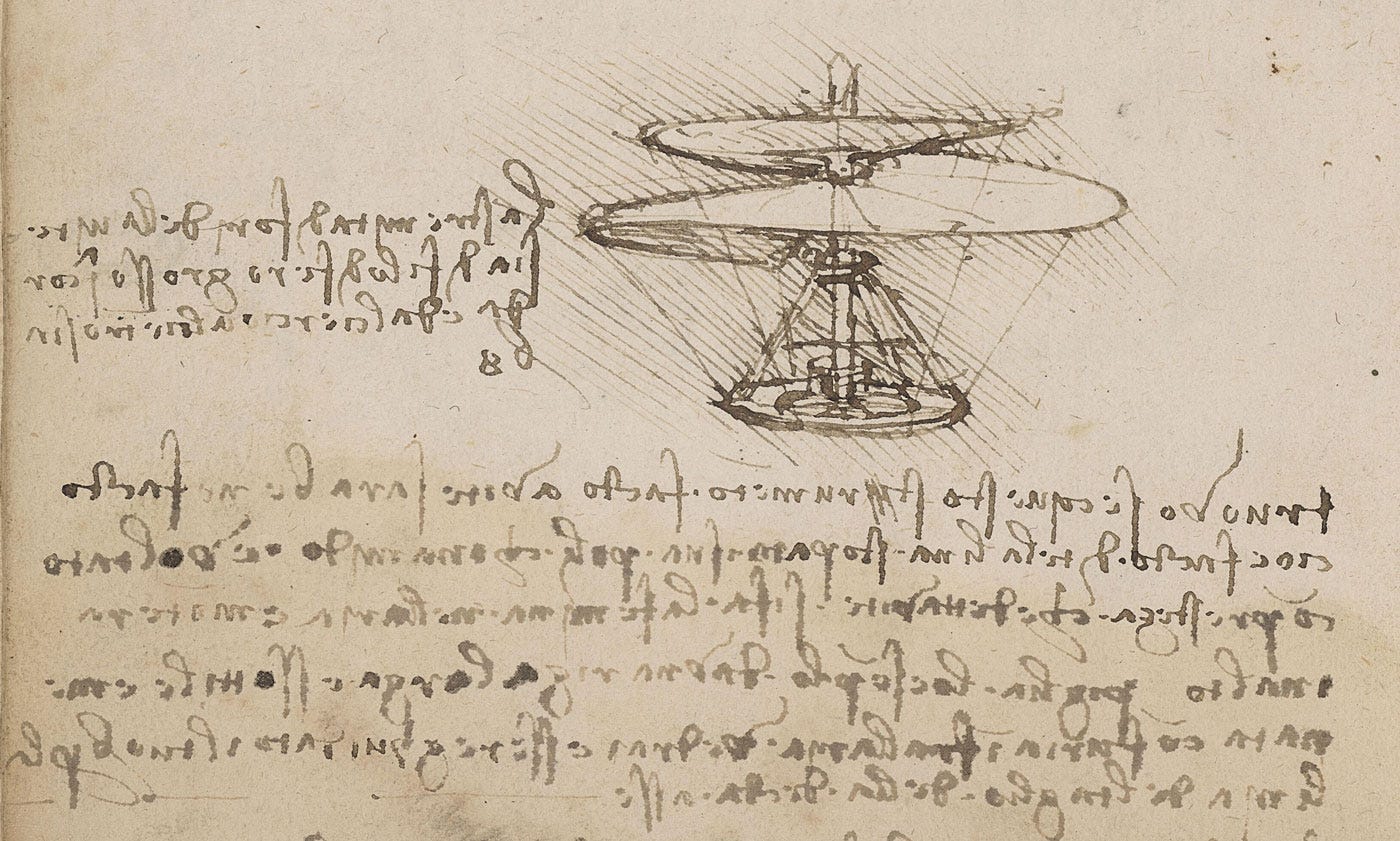
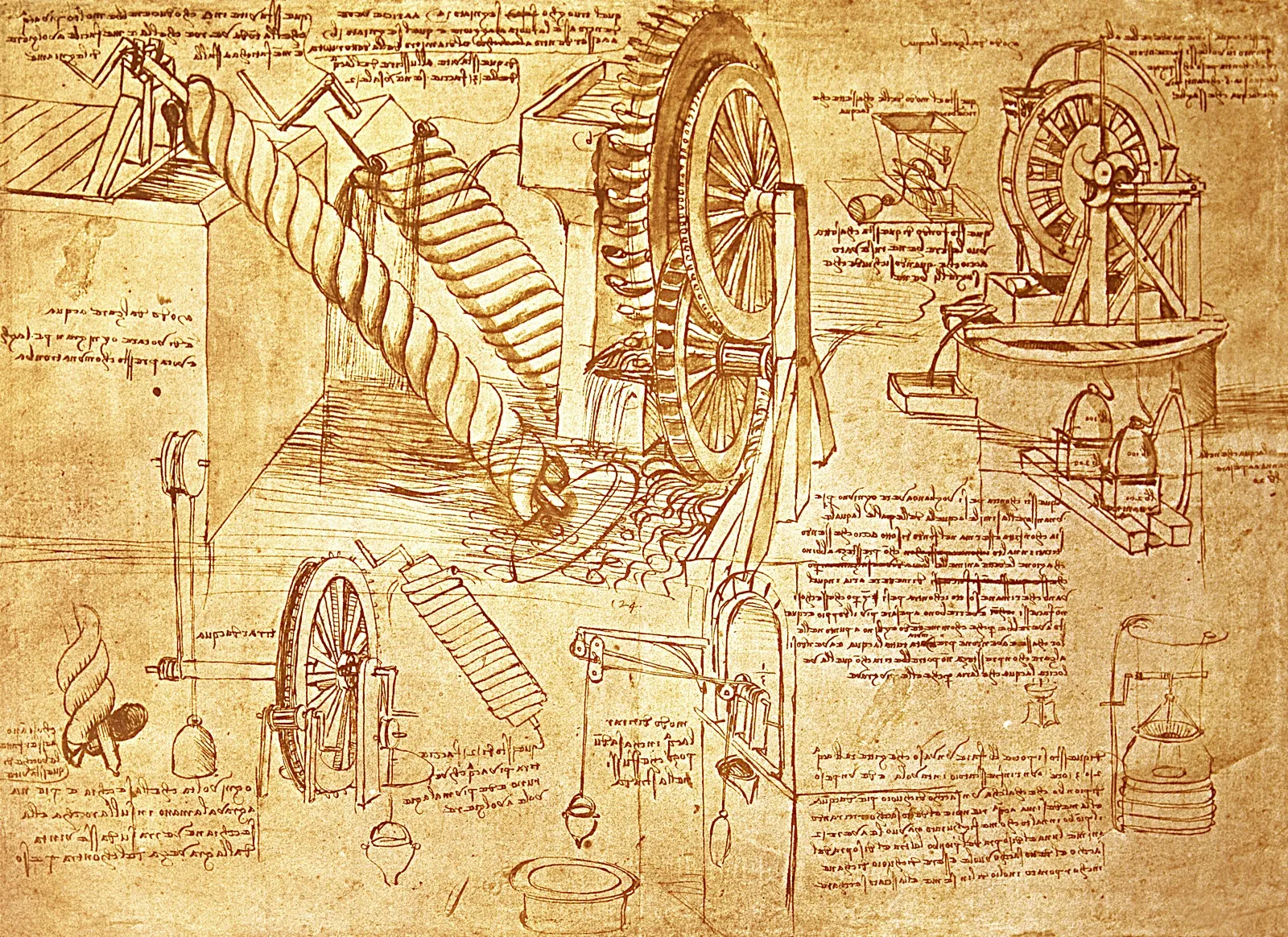
From Leonardo da Vinci's notebooks · public domain. 500 years later, same move: notice, draw, figure it out.
People have always used frameworks to stay steady through big change — stories, mental models, the wisdom we pass down. This is just one lens, built for this moment — not the answer, an answer, from someone who's spent years building with these tools and asking what keeps the human in charge.
— Built by Kareem Akabashorun, a software engineer who's spent years building with AI and thinking about how people and machines should work together.
The good future isn't humans versus the machine. It's a generation that grew up knowing how to build with it — and how to keep the wheel. It starts with one kid, one real problem, one corner of the sky.